
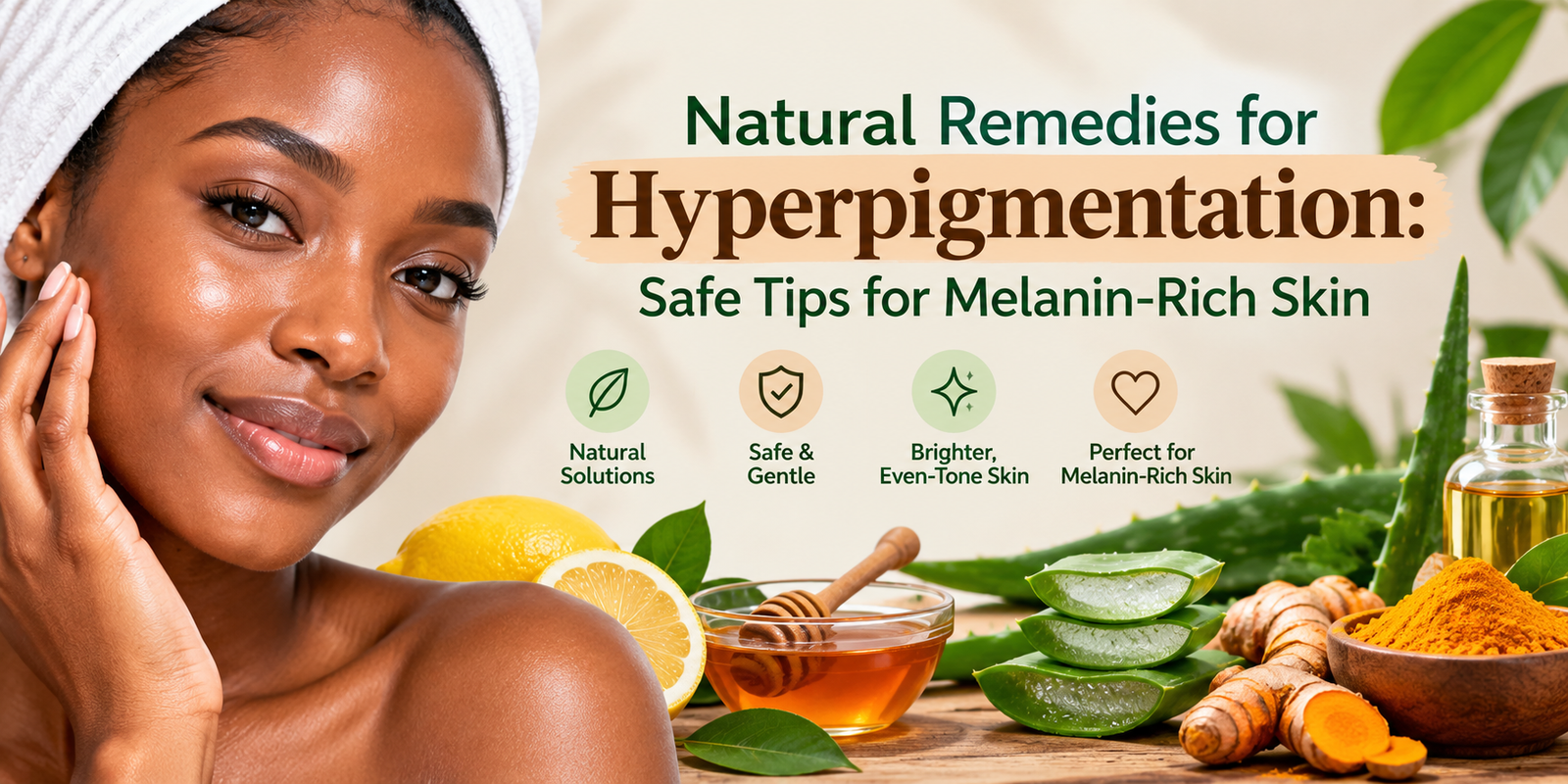
Natural Remedies for Hyperpigmentation: Safe Tips for Melanin-Rich Skin
Dark spots can be frustrating, especially when one blemish disappears only to leave a brown or darker mark behind. For people with melanin-rich skin, pigmentation can sometimes appear more noticeable and persist for longer after inflammation or injury.
The good news is that caring for hyperpigmentation does not have to mean using harsh products or trying every viral DIY treatment you see online. A consistent skincare routine focused on sun protection, gentle cleansing, moisturization and avoiding skin irritation can make a meaningful difference to the appearance and prevention of dark spots.
So, what are the best natural remedies for hyperpigmentation?
Natural skincare can be part of a sensible routine, but it is important to separate gentle, supportive practices from home remedies that may actually irritate the skin. Dermatology guidance shows that inflammation and irritation can contribute to pigmentation, particularly in darker skin tones.
This guide explains practical ways to care for hyperpigmented skin, including considerations for melanin-rich skin and the hot, sunny UAE climate.
Natural remedies for hyperpigmentation include gentle skincare, adequate moisturization, soothing ingredients, avoiding irritation, and consistent sun protection. However, natural does not automatically mean safe. Lemon juice, undiluted essential oils, baking soda and abrasive scrubs can irritate the skin and potentially make dark marks worse.
For melanin-rich skin, prevention is particularly important. Daily broad-spectrum sunscreen, gentle products and treating the underlying cause of pigmentation can help prevent existing dark spots from becoming darker and reduce the formation of new ones.
What Is Hyperpigmentation?
Hyperpigmentation refers to areas of skin that become darker than the surrounding skin because of increased or uneven pigment production.
One common type is post-inflammatory hyperpigmentation (PIH). It can occur after inflammation or injury, including acne, insect bites, cuts, burns or certain skin conditions. It is particularly common in darker skin types and may be more intense or longer-lasting.
Other forms of pigmentation include melasma and sun-related pigmentation. Because different types can have different triggers, identifying the reason behind your dark spots is an important first step.
Why Is Hyperpigmentation Common on Melanin-Rich Skin?
Melanin is the pigment responsible for skin colour. When the skin experiences inflammation or injury, melanocytes can increase pigment production.
For darker skin tones, this response can result in more noticeable pigmentation. Even everyday irritation from unsuitable skincare products can contribute to dark marks.
This is why a skincare routine for melanin-rich skin should not focus only on fading existing marks. It should also focus on preventing new inflammation and protecting the skin from environmental triggers.
1. Protect Your Skin From the Sun
If you are searching for natural remedies for hyperpigmentation, start with something simple: sun protection.
Sun exposure can darken existing pigmentation. Visible light can also contribute to hyperpigmentation, particularly in darker skin tones. Dermatologists recommend broad-spectrum sunscreen with SPF 30 or higher, and tinted sunscreen containing iron oxide can provide additional protection from visible light.
This is especially relevant in the UAE, where strong sunlight is part of everyday life.
Make Sun Protection a Daily Habit
A practical routine includes:
- Applying sunscreen to exposed skin before going outdoors.
- Reapplying approximately every two hours when outdoors, or after swimming or heavy sweating.
- Wearing sunglasses and protective clothing.
- Seeking shade when possible.
- Considering a tinted sunscreen containing iron oxide if pigmentation is a concern.
You can explore Serina Cosmetics’ verified Sunscreen collection when looking for sun-protection options.
2. Keep Your Skincare Routine Gentle
One of the most overlooked natural approaches to hyperpigmentation is simply not irritating your skin.
If a skincare product burns, stings or causes persistent redness, continuing to use it can be counterproductive. Dermatologists recommend gentle skincare because irritation can contribute to the formation or worsening of dark spots.
A simple routine can include:
Morning:
- Gentle cleanser.
- Suitable treatment product if needed.
- Moisturizer.
- Sunscreen.
Evening:
- Gentle cleanser.
- Suitable treatment product.
- Moisturizer.
Avoid introducing multiple strong products at the same time. Your skin needs time to adjust.
3. Aloe Vera: A Gentle, Soothing Option
Aloe vera is widely used in skincare because of its soothing and moisturizing properties. For someone who enjoys plant-based skincare, a properly formulated aloe-based product may be a useful addition to a gentle routine.
However, aloe vera should not be presented as a guaranteed cure for hyperpigmentation.
The goal is to support comfortable, healthy-looking skin while avoiding unnecessary irritation.
If you use fresh plant material or a homemade preparation, remember that natural substances can still cause irritation or allergic reactions. A formulated cosmetic product may provide more predictable application and preservation.
4. Oatmeal for Gentle Skin Care
Oatmeal is another traditional skincare ingredient associated with soothing and cleansing routines.
Rather than aggressively scrubbing the skin with coarse particles, consider products formulated to cleanse or support the skin gently.
This is particularly important for people with melanin-rich skin because repeated irritation can trigger post-inflammatory pigmentation.
The principle is simple:
Gentle care is better than aggressive exfoliation.
5. Moisturize Consistently
Moisturization does not directly “erase” hyperpigmentation, but maintaining comfortable, well-moisturized skin is an important part of a healthy skincare routine.
A moisturizer can help support the skin barrier and reduce the temptation to use harsh products when the skin feels dry or rough.
Look for a moisturizer appropriate for your skin type and use it consistently rather than constantly changing products.
For body pigmentation, a suitable body lotion can also make areas such as the elbows, knees and feet feel smoother and more comfortable.
6. Be Careful With Natural Exfoliation
Exfoliation can help remove surface dead skin cells, but more is not necessarily better.
Over-exfoliating can cause irritation, dryness and inflammation, which may worsen the appearance of pigmentation.
If you choose an exfoliating product, follow the manufacturer’s directions and avoid aggressively rubbing dark areas in an attempt to make them lighter.
Serina Cosmetics offers a verified Skincare collection containing categories such as scrubs, cleansers, serums, moisturizers, oils and spot correctors. Choose products based on your skin’s needs rather than simply selecting the strongest-looking option.
7. Avoid Lemon Juice and Harsh DIY Remedies
Searches for “natural remedies for hyperpigmentation” often lead people toward lemon juice, baking soda, undiluted vinegar or essential oils.
Natural does not automatically mean gentle.
Applying highly acidic or irritating household ingredients directly to the skin can cause irritation. Since inflammation can contribute to post-inflammatory hyperpigmentation, an aggressive DIY treatment can potentially make the original problem worse.
Avoid using:
- Lemon or lime juice directly on the skin.
- Household bleach.
- Baking soda as a facial scrub.
- Undiluted essential oils.
- Extremely abrasive scrubs.
- Unverified homemade “bleaching” mixtures.
The American Academy of Dermatology specifically warns against applying liquid bleach to the skin when trying to remove dark spots.
8. Treat the Cause, Not Just the Dark Spot
If acne repeatedly creates dark marks, focusing only on pigmentation may not solve the underlying problem.
Likewise, if shaving irritation, eczema, harsh skincare or another inflammatory trigger is responsible, continuing that trigger can result in new pigmentation.
The American Academy of Dermatology recommends identifying and addressing the cause of dark spots. Once the trigger is controlled, pigmentation can gradually fade over time.
Think of your skincare strategy as:
Prevent → Protect → Calm → Correct → Maintain
This approach is more sustainable than constantly searching for a stronger spot-removal product.
Natural Remedies vs. Evidence-Based Skincare
There is an important distinction between natural skincare practices and proven treatments for hyperpigmentation.
Some ingredients used in modern skincare are derived from or inspired by natural sources, while others are laboratory-developed. What matters is whether the finished product is appropriate for the intended use and whether its ingredients and instructions are clearly disclosed.
Dermatologists may recommend ingredients such as azelaic acid, glycolic acid, kojic acid, retinoids and vitamin C for certain types of dark spots. Treatment depends on the cause and the individual skin.
If pigmentation is persistent, widespread, rapidly changing or difficult to identify, professional assessment is preferable to experimenting with increasingly aggressive home remedies.
Hyperpigmentation and Melanin-Rich Skin
Melanin-rich skin deserves skincare that respects its natural colour rather than treating darker skin as a problem that needs to be “bleached.”
The objective should be healthy-looking, even-looking skin while preserving your natural complexion.
Post-inflammatory pigmentation can be especially noticeable in darker skin and may persist longer.
For African and melanin-rich skin, consider:
- Avoiding unnecessary irritation.
- Using sunscreen consistently.
- Treating acne and inflammation appropriately.
- Introducing new products gradually.
- Patch testing when appropriate.
- Avoiding aggressive scrubbing.
- Being patient with pigmentation.
- Seeking professional advice when the cause is unclear.
How Long Does Hyperpigmentation Take to Fade?
There is no universal timeline.
Once the underlying trigger has been addressed, some pigmentation gradually becomes less noticeable. The AAD notes that a dark spot a few shades darker than the person’s natural skin colour can take 6–12 months to fade, while deeper pigmentation may take considerably longer.
This is why consistency matters.
Changing products every few days makes it difficult to determine what is helping or irritating your skin.
When Should You See a Dermatologist?
Consider professional advice if:
- A dark patch appears suddenly without an obvious explanation.
- Pigmentation continues to spread.
- A spot changes in appearance.
- Your skin becomes painful, swollen or persistently irritated.
- Home skincare is not helping.
- You have significant melasma.
- You are unsure whether a mark is pigmentation or another skin condition.
A dermatologist can determine the likely cause and recommend an appropriate treatment plan.
Serina Cosmetics has a dedicated Skin Care category with products across categories including serums, lotions, creams, cleansers, scrubs, oils, spot correctors, moisturizers and sunscreen.
For customers specifically looking for products that fit into a pigmentation-conscious routine, the following verified Serina Cosmetics options may be worth exploring:
Madam White Exclusive Lightening Serum 60ml
Serina Cosmetics lists Madam White Exclusive Lightening Serum 60ml as a body-applied serum marketed for brightening and evening the appearance of skin tone. Its product page states that it is intended for use on clean, dry body skin and should be massaged gently until absorbed. View Madam White Exclusive Lightening Serum 60ml
Active Caviar Drip Skin Booster Brightening Elixir Body Oil 300ml
Serina Cosmetics lists this body oil as a lightweight product designed to improve the appearance of radiance, texture and even-looking skin tone. It may be considered by customers looking for a moisturizing body-care step alongside a broader skincare routine.
View Active Caviar Drip Skin Booster Brightening Elixir Body Oil 300ml
Madam White Exclusive Extra Whitening Milk 250ml
Serina Cosmetics describes this body lotion as a moisturizing product marketed for discoloration, dark spots and uneven-looking areas such as knuckles, knees, elbows and feet. The product page recommends patch testing and following its directions.
View Madam White Exclusive Extra Whitening Milk 250ml
Product formulations and packaging can change, so always read the current product label and manufacturer’s directions before use.
BUYING GUIDE / PRACTICAL TIPS
When choosing skincare for hyperpigmentation, consider these factors:
1. Look at the complete ingredient list
Do not choose a product simply because the front label says “natural,” “brightening” or “dark spot.”
2. Choose according to your skin type
Dry, oily, combination and sensitive skin may require different textures and routines.
3. Prioritize sun protection
A pigmentation routine without adequate sun protection can be difficult to maintain. Consider products offering broad-spectrum SPF 30 or higher, with tinted options containing iron oxide being particularly useful for visible-light protection in darker skin tones.
4. Patch test new products
Especially when introducing a new active or botanical product, test it according to the product’s instructions before applying it widely.
5. Don’t buy based only on promises
Avoid products promising instant, permanent or guaranteed removal of pigmentation.
6. Check directions carefully
A product intended for the body may not necessarily be appropriate for the face. Follow the manufacturer’s instructions.
COMMON MISTAKES
Mistake 1: Scrubbing dark spots aggressively
More friction does not necessarily mean faster results. Excessive rubbing can irritate the skin.
Mistake 2: Using lemon juice
Its acidity can irritate skin and potentially worsen pigmentation.
Mistake 3: Skipping sunscreen
Sun and visible light can contribute to pigmentation, especially in darker skin tones.
Mistake 4: Using too many products
Layering several strong products can increase irritation.
Mistake 5: Expecting overnight results
Pigmentation can take months to fade, particularly when it is deeper in the skin.
Mistake 6: Ignoring the cause
If acne, irritation or another inflammatory problem continues, new dark spots may keep appearing.
Mistake 7: Assuming “natural” means risk-free
Plant-based ingredients can still irritate or cause allergic reactions. Always use products according to their directions.
FAQ
What are the best natural remedies for hyperpigmentation?
Gentle skincare, moisturization, soothing ingredients, avoiding irritation and consistent sun protection are among the most practical natural approaches. However, natural remedies should complement—not replace—appropriate treatment when pigmentation has an identifiable medical cause.
How can I reduce hyperpigmentation naturally on dark skin?
Start by identifying the trigger, protecting your skin from sunlight, avoiding irritation and maintaining a consistent skincare routine. Melanin-rich skin can develop more noticeable post-inflammatory pigmentation, making prevention especially important.
Does aloe vera remove hyperpigmentation?
Aloe vera can be used as part of a soothing skincare routine, but it should not be considered a guaranteed treatment for hyperpigmentation. Persistent pigmentation may require targeted skincare or professional assessment.
Can lemon juice remove dark spots?
Lemon juice is not recommended as a DIY dark-spot treatment. Irritation can worsen pigmentation, particularly when the skin is prone to post-inflammatory hyperpigmentation.
Does sunscreen help hyperpigmentation?
Yes. Sun protection can help prevent existing dark spots from becoming darker and can support the overall management of pigmentation. Dermatologists recommend broad-spectrum SPF 30 or higher, while tinted sunscreen containing iron oxide can offer additional protection from visible light.
How long does hyperpigmentation take to fade naturally?
The timeline varies. Some superficial dark spots can take several months to fade after the underlying trigger is controlled. Deeper pigmentation may take much longer.
Is hyperpigmentation more common in melanin-rich skin?
Post-inflammatory hyperpigmentation is particularly common and often more pronounced in darker skin types. It can follow acne, inflammation, injury and irritation.
When should I see a dermatologist for dark spots?
See a dermatologist if pigmentation is persistent, spreading, changing, unexplained, painful or associated with other symptoms, or if your skincare routine is not improving the concern.
Conclusions
The best approach to hyperpigmentation is not necessarily the strongest product or most aggressive home remedy.
For melanin-rich skin, focus on prevention, protection and consistency. Identify what is triggering the pigmentation, avoid unnecessary irritation, moisturize regularly and protect exposed skin from UV and visible light.
Natural ingredients can have a place in skincare, but natural does not automatically mean effective or safe. Avoid harsh DIY treatments such as lemon juice, baking soda and household bleach.
If dark spots persist or their cause is unclear, professional dermatological advice can help you determine the appropriate treatment.
For customers in the UAE, GCC and worldwide, Serina Cosmetics provides access to a broad selection of skincare products, including serums, moisturizers, lotions, oils, scrubs, spot correctors and sunscreens.
Ready to build a more consistent skincare routine for uneven-looking skin tone?
Explore Serina Cosmetics’ Skin Care collection and discover skincare products for different skin types and beauty routines. Choose products carefully, follow the directions and give your skin time to respond.
Shop Skin Care at Serina Cosmetics
For sun protection, explore the Serina Cosmetics Sunscreen collection.
Healthy-looking skin starts with consistent care shop Serina Cosmetics today.
Follow Serina Cosmetics for skincare tips, African beauty inspiration, new products, beauty education and updates:
Facebook: https://www.facebook.com/serinacosmetic
Instagram: https://www.instagram.com/serinacosmetic
TikTok: https://www.tiktok.com/@serinacosmetics
YouTube: https://www.youtube.com/@SerinaCosmetic
Follow Serina Cosmetics and join our growing beauty community.