
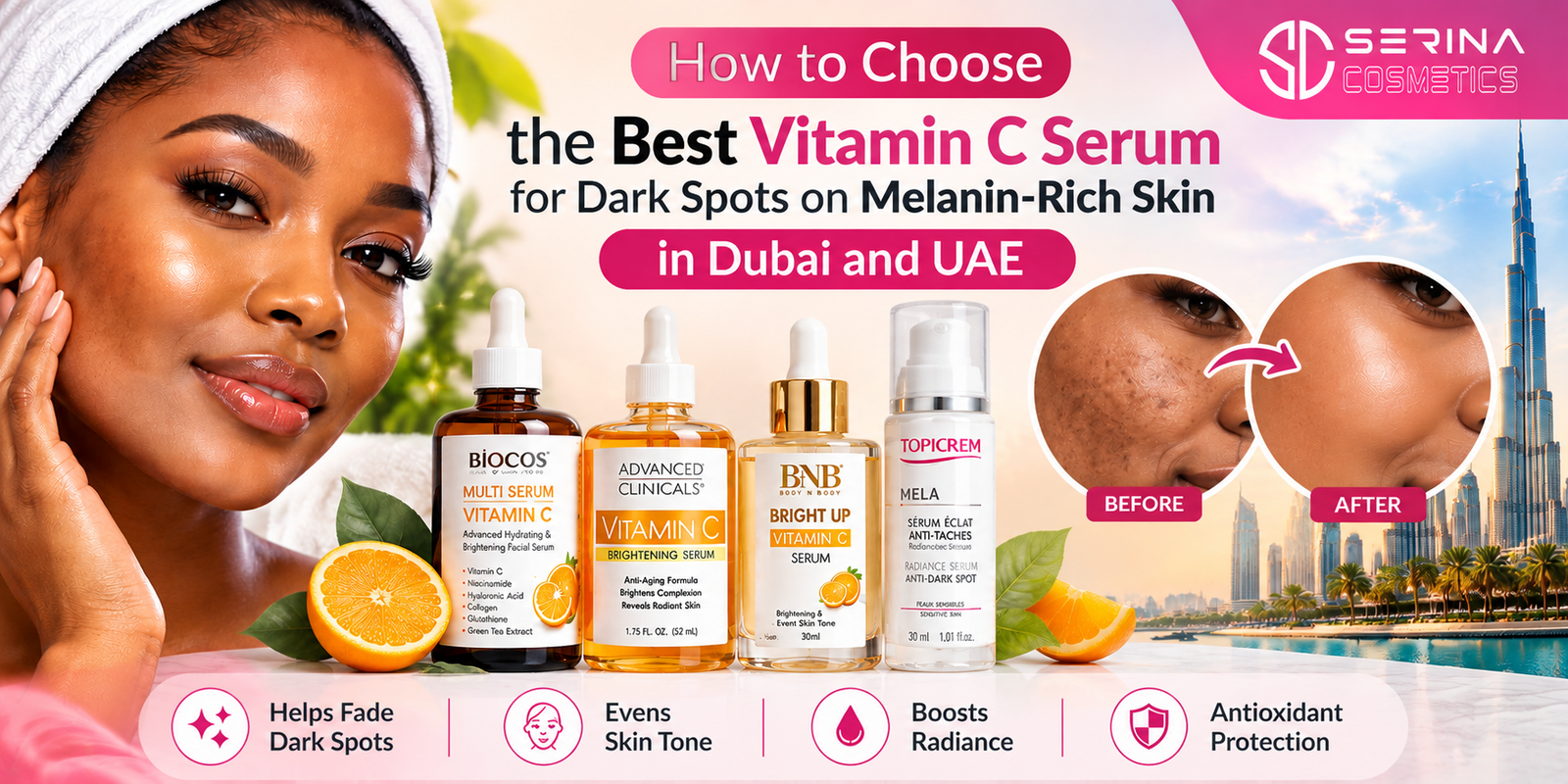
How to Choose the Best Vitamin C Serum for Dark Spots on Melanin-Rich Skin in Dubai and UAE
Dark spots, acne marks and uneven skin tone can affect people of every skin tone, but hyperpigmentation can be particularly persistent in melanin-rich skin. If you live in Dubai or elsewhere in the UAE, sun exposure, acne breakouts, hormonal changes and skin irritation may contribute to visible pigmentation.
Choosing the right skincare products can make a difference to how your skin looks and feels. One ingredient worth understanding is vitamin C, an antioxidant commonly used in brightening skincare routines.
But with so many serums available, how do you choose the best vitamin C serum for dark skin? Should you look for a particular concentration? Which ingredients work well alongside vitamin C? And how can you protect your skin from further pigmentation in the UAE climate?
This guide explains what to look for, how to use vitamin C safely and which products you can explore at Serina Cosmetics, your online destination for beauty and skincare products in the UAE.
Explore skincare options: Shop facial serums at Serina Cosmetics.
What Is Hyperpigmentation on Melanin-Rich Skin?
Hyperpigmentation occurs when areas of the skin develop darker pigmentation than the surrounding skin. It can appear as small brown spots, dark acne marks, patches or an uneven complexion.
Melanin is the natural pigment responsible for skin, hair and eye colour. When the skin experiences inflammation or certain hormonal and environmental triggers, pigmentation can become more noticeable.
Common types of pigmentation include:
- Post-inflammatory hyperpigmentation: Dark marks left after acne, eczema, irritation or other inflammation.
- Sun-related pigmentation: Dark spots associated with accumulated exposure to ultraviolet radiation.
- Melasma: Brown or grey-brown patches that can be influenced by hormonal changes and sun exposure.
- Uneven skin tone: Differences in pigmentation across the face or other areas of the body.
Identifying the likely cause of your dark spots helps you select appropriate skincare. Vitamin C may help improve the appearance of some forms of pigmentation, but it is not a complete treatment for every pigmentation condition.
Why Consider Vitamin C Serum for Dark Spots?
Vitamin C is a popular ingredient in skincare because it provides antioxidant benefits and can support a brighter-looking complexion.
When incorporated into a suitable routine, a well-formulated vitamin C serum may help with the following concerns.
1. The appearance of dark spots
Vitamin C can influence processes involved in melanin production. With consistent use, some formulations may help improve the appearance of uneven pigmentation.
2. Dull-looking skin
A vitamin C serum may help skin look brighter and more radiant, particularly when dullness is associated with environmental stress and an inconsistent skincare routine.
3. Environmental stress
Vitamin C provides antioxidant activity that helps protect skin against oxidative stress. It complements, but does not replace, sunscreen.
4. Visible signs of ageing
Vitamin C is involved in collagen synthesis, and suitable topical formulations may help improve certain visible signs of photoageing over time.
Results depend on the formulation, concentration, packaging, storage, skin condition and consistency of use.
How to Choose the Best Vitamin C Serum for Dark Skin
Not every serum is formulated in the same way. Before purchasing a product, consider these six factors.
1. Check the type of vitamin C
Vitamin C can appear in skincare products in several forms.
L-ascorbic acid: A well-studied form of vitamin C used in many antioxidant serums. It can be effective but may cause irritation in some people, especially in stronger formulations.
Sodium ascorbyl phosphate: A vitamin C derivative used in certain brightening and acne-focused formulations.
Ascorbyl glucoside: A derivative often used in products designed for a brightening skincare routine.
Magnesium ascorbyl phosphate: Another derivative used in cosmetic formulations, including products targeting uneven skin tone.
These forms differ in stability, formulation requirements and available evidence. A product’s overall formulation matters more than the ingredient name alone.
2. Choose an appropriate concentration
Some facial serums contain around 5% vitamin C, while others contain 10%, 15% or 20% or more.
A higher concentration does not automatically mean better results. Stronger products may be more irritating, and irritation can make pigmentation worse in susceptible skin.
If you are new to vitamin C, consider starting with a gentler formulation and following the manufacturer’s instructions. Do not choose a product based on concentration alone.
3. Look for complementary ingredients
Some ingredients can complement vitamin C in a pigmentation-focused skincare routine.
- Niacinamide: Supports the skin barrier and can help improve the appearance of uneven tone.
- Hyaluronic acid: Helps hydrate the skin.
- Vitamin E: An antioxidant used in some vitamin C formulations.
- Ferulic acid: Used in certain antioxidant formulations to help support stability and antioxidant performance.
- Glycerin: Helps attract and retain moisture in the skin.
You do not need every ingredient in one serum. Select a formula that suits your skin and use other products as needed.
4. Consider your skin type
For oily skin, a lightweight serum may feel more comfortable. Dry skin may benefit from a serum paired with a moisturiser containing hydrating ingredients. Sensitive skin may tolerate a gentler derivative better than a highly concentrated L-ascorbic acid formula.
If you have eczema, rosacea or a compromised skin barrier, seek professional guidance before introducing an active product.
5. Check packaging and storage
Some vitamin C formulations can deteriorate when exposed to air, light or heat. Choose products with appropriate packaging and store them according to the manufacturer’s instructions.
If a product changes noticeably in colour, smell or texture, check the manufacturer’s guidance before continuing to use it.
6. Buy from a reliable retailer
Check product descriptions, ingredient lists, expiry information where available and storage instructions. Avoid unverified products that promise instant whitening or dramatic changes to your natural complexion.
At Serina Cosmetics, you can explore skincare products and compare available serum options before choosing a product for your routine.
Vitamin C Serum Products to Explore at Serina Cosmetics
If you are looking for vitamin C serum online in Dubai or elsewhere in the UAE, the following products are options to compare. Product formulations and availability may change, so review the current product listing before purchasing.
1. Biocos Multi Serum Vitamin C
Best for: Those looking for a multi-ingredient brightening and hydrating serum.
The product is marketed as a vitamin C facial serum featuring ingredients such as niacinamide and hyaluronic acid, according to its product description.
Potential reasons to consider it include:
- A combination of brightening and hydrating skincare ingredients.
- A multi-purpose addition to a routine for dullness and uneven tone.
- An option for shoppers who prefer a serum combining several skincare ingredients.
Review the complete ingredient list and directions to confirm that the formulation suits your skin.
Shop: Biocos Multi Serum Vitamin C
2. Advanced Clinicals Vitamin C Brightening Serum 52ml
Best for: People seeking an antioxidant-focused serum for dullness and visible signs of ageing.
This product is marketed as a vitamin C brightening serum, with ferulic acid highlighted in its product description.
Consider it if you want to compare an antioxidant-focused formulation with other available brightening serums.
Shop: Advanced Clinicals Vitamin C Brightening Serum 52ml
3. BNB Bright Up Vitamin C Serum 30ml
Best for: Shoppers comparing vitamin C products for a brightening routine.
BNB Bright Up Vitamin C Serum is marketed for a brighter-looking complexion and uneven skin tone.
Before purchasing, check the current ingredient list, recommended application frequency and suitability for your skin type.
Explore: Serina Cosmetics Serum Collection
4. Topicrem MELA Anti-Dark Spot Radiance Serum 30ml
Best for: People looking for a targeted product marketed for the appearance of dark spots.
Topicrem MELA Anti-Dark Spot Radiance Serum is marketed for pigmentation and radiance concerns. Compare its formulation and directions with your current skincare routine before choosing it.
Shop: Topicrem MELA Anti-Dark Spot Radiance Serum
Shopping tip: These products are not presented as clinically ranked winners. The most suitable option depends on your skin, the formulation and the cause of your pigmentation.
How to Build a Vitamin C Skincare Routine in Dubai
A consistent, uncomplicated routine can help you introduce active skincare without unnecessarily irritating your skin.
Morning routine
Step 1: Cleanse your face. Use a gentle cleanser suited to your skin type.
Step 2: Apply vitamin C serum. Follow the product directions and avoid the eyes, broken skin and irritated areas.
Step 3: Moisturise. Apply a suitable moisturiser to help maintain the skin barrier.
Step 4: Apply sunscreen. Finish with broad-spectrum SPF 30 or higher. SPF 50 can be a practical choice for regular outdoor exposure in the UAE.
Browse sunscreen products at Serina Cosmetics to explore options for your daily routine.
Evening routine
In the evening, cleanse your skin and apply a suitable moisturiser. If you use additional pigmentation treatments, introduce them carefully and follow their instructions.
Avoid introducing multiple new active ingredients simultaneously. This makes it easier to identify which product is helping or causing irritation.
Can Vitamin C Serum Make Dark Spots Worse?
Vitamin C does not ordinarily cause pigmentation to worsen when a suitable product is used correctly, but irritation from a formulation can trigger inflammation and potentially worsen post-inflammatory hyperpigmentation.
Stop using the product if you experience persistent burning, redness, itching, swelling or worsening irritation.
To reduce the risk of problems:
- Patch-test new products according to their instructions.
- Introduce active ingredients gradually.
- Avoid applying serum to damaged or irritated skin.
- Do not over-exfoliate.
- Use sunscreen consistently.
- Seek advice from a dermatologist if pigmentation becomes persistent or more pronounced.
If your skin is sensitive, choosing a gentler product and introducing it slowly may be more useful than pursuing the strongest available serum.
Why Sunscreen Matters for Hyperpigmentation in the UAE
Sun protection is one of the most important steps in a routine designed to manage dark spots.
Dubai and other UAE cities experience substantial sunshine throughout the year. UV exposure can contribute to pigmentation and make existing dark spots more noticeable.
Choose a broad-spectrum sunscreen with SPF 30 or higher, apply it generously according to its directions and reapply as recommended, particularly during extended outdoor exposure.
If melasma is a concern, ask a dermatologist whether a tinted sunscreen containing iron oxides may provide additional protection against visible light.
For more guidance, read our related article: Sunscreen for Dark Skin: Do You Really Need It?.
How Long Does Vitamin C Take to Improve Dark Spots?
There is no single timeline that applies to everyone.
Some people may notice an improvement in radiance before they see changes in dark spots. Pigmentation can take several weeks or months to improve, and some forms may require prescription treatment or other professional interventions.
Your results may depend on:
- The cause and depth of the pigmentation.
- The type and stability of the vitamin C formulation.
- How consistently you use the product.
- Whether you use sun protection.
- Whether acne or another inflammatory condition is continuing to create new marks.
Avoid judging a product after only a few applications. Follow its instructions, protect your skin and seek professional advice if you are concerned about persistent pigmentation.
Common Mistakes to Avoid When Treating Dark Spots
Using too many active ingredients
Combining several strong exfoliants, retinoids and brightening treatments can irritate the skin. Build your routine gradually.
Skipping sunscreen
A serum cannot compensate for inadequate sun protection. Daily sunscreen is essential when managing pigmentation.
Expecting overnight results
Dark spots usually take time to improve. Be cautious of products promising dramatic results within a few days.
Choosing products that promise skin whitening
The aim of a pigmentation-focused routine should be to improve uneven marks while protecting your natural skin tone and skin barrier, not to change your natural complexion.
Ignoring persistent pigmentation
Melasma, changing spots and stubborn pigmentation may require medical assessment. A dermatologist can help identify the cause and recommend suitable treatment.
Where to Buy Vitamin C Serum Online in Dubai and UAE
Looking for vitamin C serum in Dubai, brightening serum in Abu Dhabi or skincare products for dark spots in Sharjah?
Serina Cosmetics provides an online destination for exploring skincare products for different skin types and concerns.
Start by browsing these collections:
Compare product descriptions, ingredients and directions before choosing the option that best suits your needs.
If you are unsure which product to select, consider your main concern, skin sensitivity and current routine before purchasing.
Frequently Asked Questions
1. Which vitamin C serum is best for dark skin in Dubai?
The best option depends on your skin type, the cause of your pigmentation and your tolerance for active ingredients. Compare products such as Biocos Multi Serum Vitamin C and Advanced Clinicals Vitamin C Brightening Serum, and check their current ingredients and directions.
2. Is vitamin C good for African skin?
Vitamin C can be suitable for African and other melanin-rich skin tones. Introduce a suitable formulation gradually, avoid irritation and use sunscreen consistently.
3. Can vitamin C remove dark spots completely?
Vitamin C may improve the appearance of some dark spots, but complete removal is not guaranteed. Melasma and persistent pigmentation may need additional treatment.
4. Should I use vitamin C serum every day?
Many products are designed for regular use, but the correct frequency depends on the formula and your skin’s tolerance. Follow the label and reduce use or discontinue the product if irritation develops.
5. Can I use vitamin C with niacinamide?
These ingredients can generally be used together in a suitable skincare routine. A combined formula may be convenient, but introducing one new product at a time can help you identify irritation.
6. Can vitamin C help with acne marks?
Vitamin C may help improve the appearance of flat, dark marks left after acne. It does not generally remove indented or raised acne scars.
7. Is vitamin C serum enough to treat hyperpigmentation?
Not always. Vitamin C can be one part of a routine, but sunscreen, management of the underlying cause and sometimes professional treatment are also important.
8. Where can I buy vitamin C serum online in the UAE?
You can explore the Serina Cosmetics Serum Collection and review the available product descriptions before ordering.
Final Thoughts: Choose the Right Vitamin C Serum for Your Skin
Finding the best vitamin C serum for dark spots on melanin-rich skin involves more than selecting a popular brand or the highest concentration. The formulation, your skin’s sensitivity, consistent sun protection and the cause of the pigmentation all matter.
Start with a suitable product, introduce it gradually and give your routine time to work.
Ready to upgrade your skincare routine? Explore the Serina Cosmetics Serum Collection and discover facial serums to complement your skincare goals.
Follow Serina Cosmetics for more beauty tips, skincare education and product updates:
- Facebook: https://www.facebook.com/serinacosmetic
- Instagram: https://www.instagram.com/serinacosmetic
- TikTok: https://www.tiktok.com/@serinacosmetics
- YouTube: https://www.youtube.com/@SerinaCosmetic
The information in this article is for general skincare education and is not a substitute for personalised medical advice.