

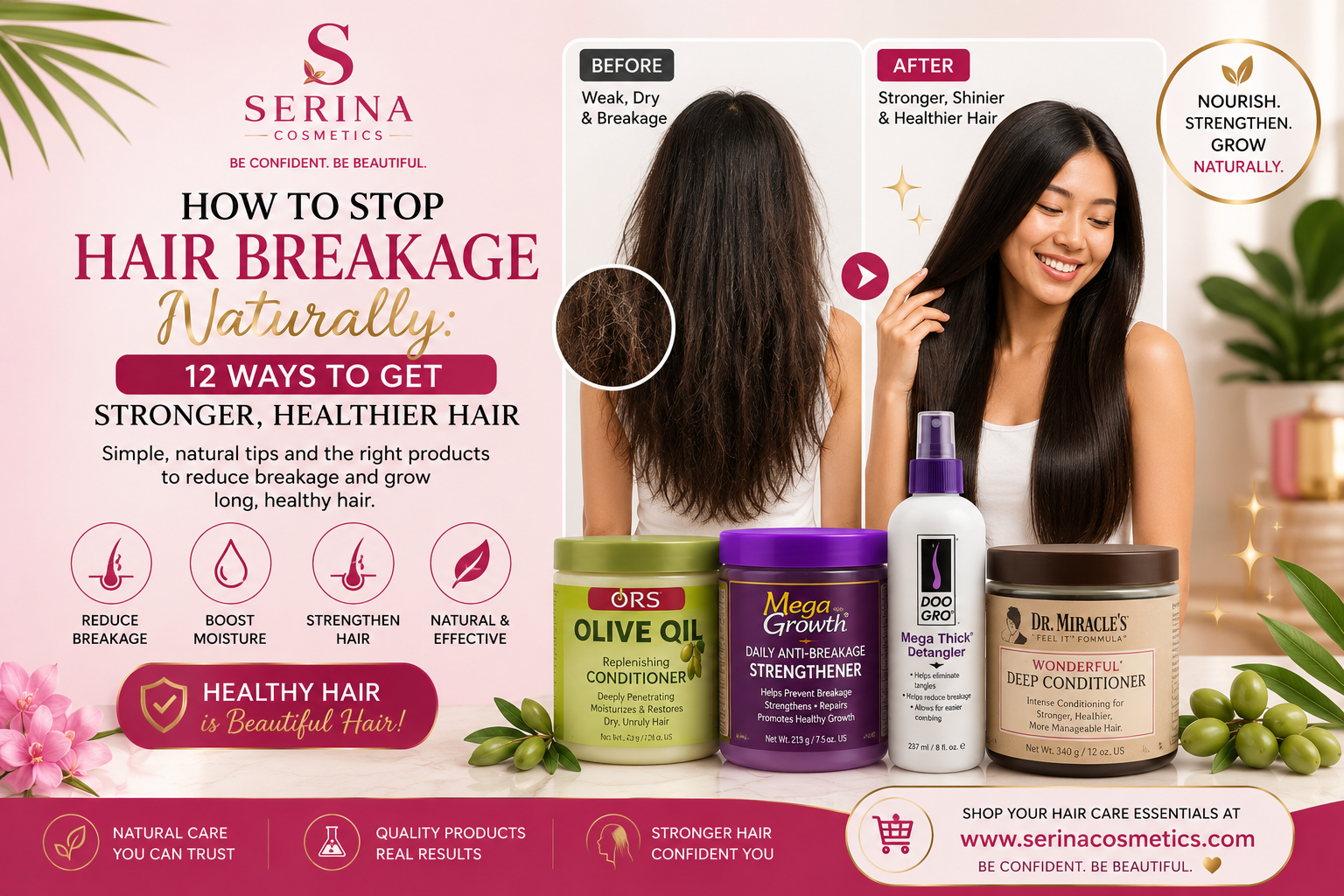
How to Stop Hair Breakage Naturally: 12 Ways to Get Stronger, Healthier Hair
Hair breakage can be frustrating. You may feel like your hair is growing, yet it never seems to get longer. You may notice short broken strands on your clothes, thinning ends, excessive tangling, split ends, or hair snapping whenever you comb or style it.
The good news is that hair breakage can often be reduced naturally by changing how you moisturize, wash, detangle, protect, and style your hair.
Whether you have natural, relaxed, curly, coily, braided, colour-treated, or chemically processed hair, building a consistent anti-breakage routine can help you retain more length and keep your strands looking stronger and healthier.
In this guide, we’ll explain how to stop hair breakage naturally, what causes hair to break, which natural ingredients may help, and how to build a simple hair-care routine for damaged or breakage-prone hair.
Looking for products for weak or damaged hair? Explore the Hair Care collection at Serina Cosmetics for shampoos, conditioners, oils, detanglers and targeted hair treatments.
What Is Hair Breakage?
Hair breakage occurs when the hair shaft becomes weak enough to snap.
Unlike normal hair shedding, where an entire strand falls from the root, breakage can happen anywhere along the hair shaft. This is why you may see lots of short hairs of different lengths rather than full-length strands.
Breakage can also make it difficult to retain length. Your hair may continue growing from the scalp, but if the ends are breaking at a similar rate, it can appear as though your hair isn’t growing.
The goal, therefore, isn’t simply to encourage growth.
You also need to protect the hair you already have.
What Causes Hair Breakage?
Understanding the cause is one of the most important steps in learning how to prevent hair breakage.
Common causes include:
- Excessive dryness
- Lack of conditioning
- Aggressive brushing and detangling
- Excessive heat styling
- Frequent chemical treatments
- Tight hairstyles
- Friction from towels and bedding
- Over-manipulation
- Split ends
- Poor hair-care practices
- Repeated colouring or bleaching
- Improper use of relaxers
- Excessive sun and environmental exposure
For curly, coily and textured hair, moisture retention can be particularly important because natural scalp oils may not travel down tightly curled strands as easily.
Fortunately, a few changes to your routine can make a major difference.
How to Stop Hair Breakage Naturally
1. Keep Your Hair Properly Moisturized
Dry hair is more likely to become brittle and break.
Think of a very dry twig compared with a flexible green branch. When hair loses too much moisture and flexibility, normal activities such as combing, styling and detangling can put additional stress on the strands.
A good moisture routine may include:
Water or a water-based moisturizer → leave-in conditioner → oil or cream to help seal moisture.
You don’t necessarily need to apply heavy products every day. The goal is to prevent your hair from repeatedly becoming extremely dry.
Explore hair conditioners at Serina Cosmetics to find options suitable for adding moisture and improving manageability.
2. Deep Condition Regularly
If your hair constantly feels rough, tangled or brittle, regular conditioning should become one of the foundations of your routine.
Deep conditioning can help improve softness, manageability and lubrication, which may reduce the mechanical stress created during combing.
Depending on your hair’s condition, consider using a moisturizing or strengthening treatment approximately once a week or as directed on the product.
Serina Cosmetics has a dedicated Hair Treatment collection featuring products designed for concerns including dryness, damaged hair, weak strands, split ends and breakage.
Product to consider
The &Honey Creamy EX Damage Repair Treatment is designed for damaged hair exposed to factors such as heat, dehydration, friction and chemical processing. It combines moisturizing and conditioning ingredients including honey, argan oil, hyaluronic acid and keratin.
Shop Hair Treatments at Serina Cosmetics
3. Use Hair Oils to Help Seal in Moisture
Natural oils can be useful additions to an anti-breakage routine, particularly when they are used to help reduce dryness and improve lubrication.
Popular hair oils include:
- Coconut oil
- Argan oil
- Castor oil
- Avocado oil
- Jojoba oil
- Olive oil
- Amla oil
- Chebe-infused oils
Hair oil does not replace water or a good conditioner. Instead, oils can be used alongside a moisturizing routine.
Apply a small amount to your strands and concentrate on areas that become dry easily, particularly the ends.
Browse Hair Oils at Serina Cosmetics for oils designed for dry, weak and breakage-prone hair.
Product to consider
Difeel Caffeine & Castor Hair Oil combines caffeine and castor oil and is designed to condition, hydrate and improve the feel and strength of the hair.
4. Detangle Your Hair Gently
One of the easiest ways to cause unnecessary breakage is aggressive detangling.
If your comb constantly fills with broken strands, your technique may be part of the problem.
Instead:
- Divide your hair into manageable sections.
- Apply conditioner or detangling product.
- Start detangling from the ends.
- Slowly work upward toward the roots.
- Hold the section above the area you’re detangling to reduce pulling.
- Use your fingers or a wide-tooth comb where appropriate.
- Never aggressively rip through knots.
Patience matters.
Taking an extra five minutes to detangle carefully can save hundreds of strands over time.
Product to consider
Doo Gro Triple Strength Anti-Breakage Growth Detangler is formulated to make detangling easier while conditioning and moisturizing the hair. It can be used on natural, relaxed, braided and colour-treated hair.
5. Reduce Excessive Heat Styling
Flat irons, curling irons, blow dryers and other heated styling tools can be useful, but excessive heat may weaken the hair shaft over time.
You don’t necessarily need to eliminate heat completely.
Instead:
- Reduce how frequently you use it.
- Avoid repeatedly passing a flat iron over the same section.
- Use the lowest effective temperature.
- Apply an appropriate heat protectant.
- Avoid using extreme heat on already damaged hair.
- Give your hair periods without heat styling.
If your hair is already breaking severely, reducing heat exposure for several weeks may help you determine whether heat is contributing to the problem.
6. Protect Your Hair While Sleeping
Your nighttime routine can have a surprisingly large effect on breakage.
Cotton pillowcases can create friction between the hair and fabric as you move during sleep.
Consider using:
- A satin bonnet
- A silk or satin scarf
- A satin pillowcase
Before bed, loosely secure your hair rather than pulling it tightly.
For curly or coily hair, dividing the hair into a few loose twists or braids may also help reduce tangling.
7. Avoid Extremely Tight Hairstyles
Braids, ponytails, buns, wigs, extensions and protective hairstyles can look beautiful, but they shouldn’t constantly hurt.
If your hairstyle creates significant tension around your edges or scalp, that tension can contribute to breakage.
Be especially careful around the hairline.
When wearing protective styles:
- Avoid excessive tension.
- Moisturize your natural hair as appropriate.
- Protect your hair at night.
- Clean your scalp when necessary.
- Give your hair breaks between high-tension styles.
A protective hairstyle is only protective when the hair underneath is being protected.
8. Pay Special Attention to Your Ends
Your ends are the oldest part of your hair.
That makes them particularly vulnerable to dryness, friction, splitting and breakage.
Give them extra attention when applying conditioner, leave-in products and oils.
You should also avoid constantly rubbing the ends against rough clothing and surfaces.
When split ends become severe, trimming them may prevent the damage from progressing farther up the strand.
9. Choose a Gentle Shampoo
Cleansing your scalp is essential, but hair that already feels extremely dry may benefit from a shampoo and washing routine that cleanses without leaving the strands excessively stripped.
Focus shampoo primarily on your scalp and allow the lather to move through the lengths while rinsing rather than aggressively rubbing the ends.
One option available from Serina Cosmetics is Difeel Pomegranate & Manuka Honey Sulfate-Free Shampoo, which is formulated with pomegranate and manuka honey for dry and brittle hair.
Another strengthening option is Mega Growth Profectiv Stimulating Shampoo, designed to address concerns including breakage, split ends and dryness.
10. Balance Moisture and Strengthening Treatments
Damaged hair often needs moisture, but some hair may also benefit from strengthening products containing proteins or similar conditioning ingredients.
The key is balance.
If your hair is:
Dry, rough and brittle: prioritize moisture.
Very weak, overly elastic or chemically damaged: a strengthening treatment may be useful.
Avoid assuming that more protein automatically means stronger hair. Follow individual product directions and pay attention to how your hair responds.
Serina Cosmetics’ Hair Treatment collection includes both moisturizing and repair-focused options.
11. Minimize Over-Manipulation
Constantly touching, combing and restyling your hair creates repeated mechanical stress.
You don’t need to comb your hair dozens of times each day for it to remain healthy.
Try low-manipulation hairstyles that allow your hair to remain relatively undisturbed for several days while still giving you access to moisturize and care for it.
Examples can include:
- Loose twists
- Loose braids
- Buns without excessive tension
- Twist-outs
- Braid-outs
- Other low-tension protective styles
Less manipulation can mean fewer opportunities for strands to snap.
12. Be Consistent
You probably won’t completely transform damaged hair after one deep-conditioning treatment.
Hair care works best when it becomes a routine.
Instead of constantly switching products, establish a simple regimen and monitor how your hair responds.
For example:
Wash → Condition → Detangle → Moisturize → Seal → Protect
Repeat consistently and adjust according to your hair’s needs.
Natural Ingredients That Can Help Support Breakage-Prone Hair
When choosing products for dry or weak hair, you may encounter ingredients such as:
Coconut Oil
Often used to condition hair and improve lubrication. It can be particularly useful as part of pre-wash or conditioning routines for some hair types.
Argan Oil
Popular in hair-care formulas because it helps condition dry hair, improve softness and add shine.
Castor Oil
A rich oil frequently used in textured-hair routines to seal moisture and lubricate dry strands.
Jojoba Oil
A lightweight oil frequently included in scalp, detangling and conditioning products.
Shea Butter
Especially popular for curly, coily and textured hair because of its rich conditioning properties.
Aloe Vera
Commonly included in moisturizing and detangling products.
Amla Oil
A traditional ingredient used in many South Asian and African-inspired hair-care routines.
Chebe
Chebe has become increasingly popular in natural-hair routines focused on moisture retention, strengthening and length retention.
Serina Cosmetics carries Amalico Chebe hair products, including Chebe oils formulated for strengthening and breakage-prone hair.
Simple Anti-Breakage Hair Routine
If you’re unsure where to begin, keep your routine simple.
Step 1: Cleanse
Wash your scalp and hair using a shampoo appropriate for your hair type and level of product buildup.
Step 2: Condition
Apply conditioner generously, concentrating on your mid-lengths and ends.
Browse Hair Conditioners.
Step 3: Deep Treat
Use a suitable Hair Treatment periodically for additional moisture or strengthening support.
Step 4: Detangle
Work in sections and detangle from ends toward roots.
Step 5: Moisturize
Apply an appropriate leave-in conditioner or moisturizer.
Step 6: Seal
Apply a small amount of Hair Oil to help maintain softness and reduce dryness.
Step 7: Protect
Choose a low-tension hairstyle and use a satin or silk bonnet/scarf while sleeping.
Consistency with these seven steps can be far more effective than buying dozens of products without having a routine.
Best Products for Hair Breakage at Serina Cosmetics
If you’re building an anti-breakage routine, start with products that address specific causes rather than buying everything at once.
For weak, dry hair:
Mega Growth Profectiv Stimulating Shampoo
For difficult detangling:
Doo Gro Triple Strength Anti-Breakage Growth Detangler
For moisture and strengthening:
For sealing moisture:
For a complete routine:
Frequently Asked Questions About Hair Breakage
How can I stop my hair from breaking naturally?
Start by reducing dryness and mechanical damage. Condition regularly, detangle gently, limit excessive heat, avoid tight hairstyles, moisturize your hair, protect it while sleeping and minimize unnecessary manipulation.
What is the best oil for hair breakage?
There isn’t one oil that is best for everyone. Coconut, argan, castor, jojoba, avocado, olive and amla oils are commonly used in conditioning routines. Choose according to your hair texture, porosity and how your hair responds.
Explore the Hair Oil collection at Serina Cosmetics to compare options.
Why does my hair keep breaking?
Repeated breakage may be associated with dryness, heat damage, chemical processing, excessive manipulation, rough detangling, tight hairstyles or split ends. Identifying where and when your hair breaks can help narrow down the cause.
Can broken hair grow back?
Hair continues to grow from healthy follicles, but a strand that has snapped cannot reconnect itself. The objective is therefore to protect new and existing growth so you can retain more length.
How often should I deep condition damaged hair?
Many people with dry or damaged hair incorporate deep conditioning approximately weekly, but the ideal frequency depends on your hair and the specific product. Always follow the manufacturer’s directions.
Can protective styles stop hair breakage?
They can reduce daily manipulation, but only when installed and maintained properly. Extremely tight braids, extensions, wigs or ponytails may increase tension and contribute to breakage.
How long does it take to reduce hair breakage?
It depends on the extent and cause of the damage. You may notice improved manageability relatively quickly after changing your routine, while visible length retention requires consistency over a longer period.
If breakage or hair loss is sudden, severe, persistent, patchy, or accompanied by scalp symptoms, consider speaking with a qualified healthcare professional or dermatologist to identify possible underlying causes.
Stop Breakage and Start Retaining Your Length
Healthy-looking longer hair isn’t only about encouraging growth.
It’s also about keeping the hair you’ve already grown.
A consistent routine built around moisture, gentle detangling, conditioning, reduced heat, low-tension styling and nighttime protection can help reduce unnecessary breakage and improve length retention.
You don’t need a complicated 20-product routine.
Start with the essentials and choose products based on what your hair actually needs.
Ready to Build Your Anti-Breakage Routine?
Explore Serina Cosmetics’ collection of hair oils, shampoos, conditioners, detanglers, deep treatments and strengthening products for natural, relaxed, curly, coily and damaged hair.
Shop Hair Care Products at Serina Cosmetics
Build your routine today and give your hair the moisture, care and protection it needs to stay stronger from wash day to wash day.